general
CCMA vs. CMA Certification: What's the Difference?
CCMA and CMA are the two most common Medical Assistant certifications, but they come from different organizations with different eligibility rules. This guide breaks down what each one requires, what the exams cover, and — most importantly — which one your training program actually qualifies you for.
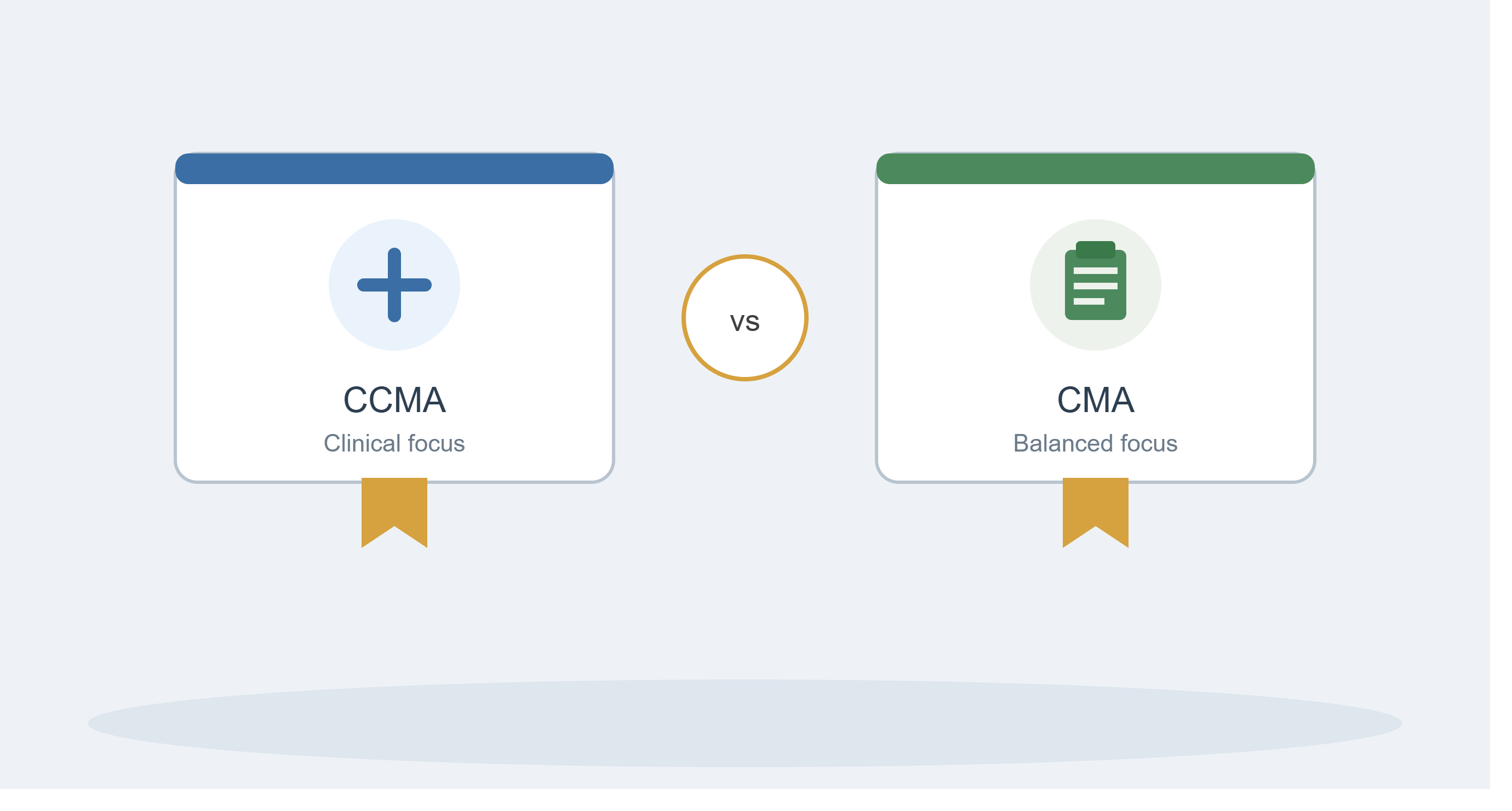
CCMA vs. CMA Certification: What's the Difference?
Once you've decided to become a Medical Assistant, the next question is usually which certification to pursue. The two most common credentials — CCMA and CMA — sound similar but come from different organizations, have different eligibility rules, and lead to slightly different career paths. Here's a clear breakdown.
What Is CCMA?
CCMA (Certified Clinical Medical Assistant) is issued by the National Healthcareer Association (NHA). It emphasizes hands-on clinical work — things like taking vital signs, preparing patients for exams, assisting with procedures, and basic phlebotomy — while still covering administrative topics.
Eligibility: You qualify by either completing a medical assistant training program or having at least one year of medical assisting work experience. This makes the CCMA accessible to graduates of a wide range of training programs, including shorter, career-focused programs that aren't formally accredited by CAAHEP or ABHES.
Exam: 200 questions covering patient care, phlebotomy, infection control, and related clinical topics.
Renewal: Every two years, typically through continuing education credits.
What Is CMA?
CMA (Certified Medical Assistant) is issued by the American Association of Medical Assistants (AAMA). It covers a broader mix of clinical and administrative topics — patient care alongside scheduling, medical records, and office management.
Eligibility: This is the key difference. To sit for the CMA exam, you must graduate from a Medical Assistant program specifically accredited by CAAHEP (Commission on Accreditation of Allied Health Education Programs) or ABHES (Accrediting Bureau of Health Education Schools). Many shorter, career-focused, or online-first training programs don't hold this specific accreditation — so their graduates aren't eligible for the CMA exam, even if the training itself is solid.
Exam: 200 multiple-choice questions covering clinical, administrative, and general knowledge topics.
Renewal: Every five years, through continuing education credits or by retaking the exam.
The Real Difference: Eligibility, Not Quality
Both credentials are respected by employers, and most healthcare settings accept either one. The practical difference isn't about which certification is "better" — it's about which one your training program actually qualifies you for.
- If your program is CAAHEP- or ABHES-accredited, you can pursue either CCMA or CMA.
- If your program isn't, CCMA is typically your path forward, since it accepts a broader range of training backgrounds, including an experience-based pathway.
This is why the CCMA has become the most commonly pursued certification for graduates of focused, vocational-style Medical Assistant programs.
Content Focus: Clinical vs. Balanced
- CCMA leans clinical — more emphasis on direct patient care tasks.
- CMA is more evenly split between clinical and administrative content, reflecting the fact that many Medical Assistants split their time between patient care and front-office work.
If your goal is to work primarily in hands-on patient care, CCMA aligns closely with that focus. If you want a credential that also signals strength in office/administrative operations, CMA's broader scope may be the better fit — provided your training program qualifies you for it.
Does Employer Preference Differ?
Most employers, including major hospital systems and outpatient clinic networks, accept either certification. Some academic medical centers occasionally show a preference for CMA specifically, but for the large majority of Medical Assistant roles, both credentials open the same doors.
Which One Should You Pursue?
For most people completing a focused Medical Assistant training program (rather than a two-year accredited associate degree), CCMA will be the realistic and appropriate path — it's the certification your training was built for, and it's the one recognized in the vast majority of job postings. If you're specifically targeting a role at an institution that names CMA as a requirement, confirm whether your training path is CAAHEP/ABHES accredited before enrolling.
Train Toward Certification in Duluth, GA
Bliss Medical Academy's Medical Assistant program is built to prepare you for the NHA Certified Clinical Medical Assistant (CCMA) exam:
- Length: 486 hours
- Cost: $4,400
- Format: Hybrid — evening lectures + weekend hands-on labs
- Location: Duluth, GA
Learn more and enroll at Bliss Medical Academy →
This article is for general informational purposes and doesn't replace guidance from NHA, AAMA, or a specific training program. Certification requirements and fees can change — confirm current details directly with the NHA or AAMA before making enrollment decisions.
Written by
Rajesh Bhatia
Keep reading
More from the blog

Is Bliss Medical Academy GNPEC Approved?
Wondering if a training program is legitimate? GNPEC authorization is the state's stamp of approval for career schools in Georgia. This post explains what GNPEC actually checks, confirms Bliss Medical Academy's current authorization, and shows why this matters more than price when comparing programs.

What to Expect in Your First Week of Phlebotomy Training?
Starting phlebotomy training soon? Here's a realistic walkthrough of your first week — from safety and terminology on day one, to equipment and procedure, to your first hands-on lab session. Includes what tends to surprise new students and how to prepare before you walk in.

How Much Does a Medical Assistant Make in Georgia?
Curious what Medical Assistants actually earn in Georgia? This guide breaks down average pay by experience level and certification status, why certification makes a real difference in your paycheck, and how a MA training program stacks up against the investment.